
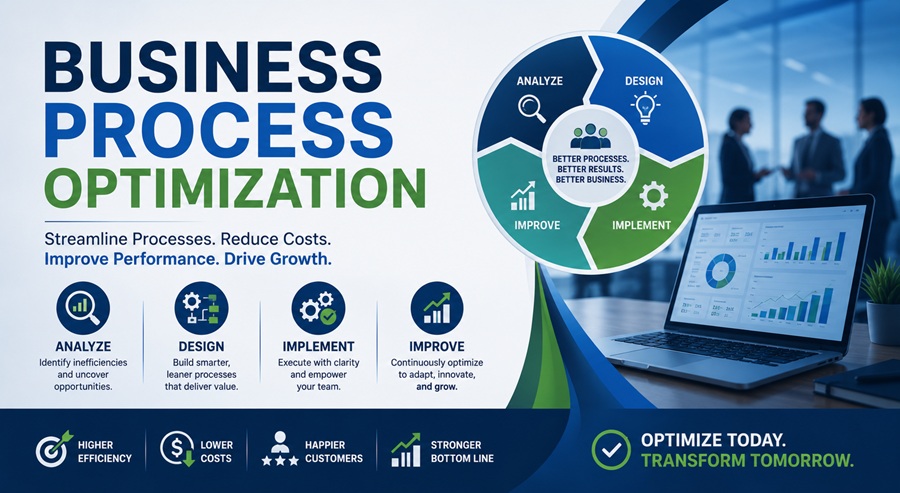
Every organization, regardless of size or industry, has processes running underneath its daily operations. Some of those processes work well. Many do not. Orders get delayed for reasons nobody can pinpoint. Approvals pile up in inboxes because ownership is unclear. Teams add new tools and dashboards without addressing the underlying workflow, and performance stays flat. Business process optimization is the discipline that addresses all of this directly, and in 2026, with cost pressures rising and competitive margins tightening across almost every sector, it has become less of an optional improvement project and more of an operational necessity.
What Business Process Optimization Actually Means
Business process optimization is a structured, data-driven approach to redesigning existing workflows so they cost less, operate faster, carry lower risk, and deliver better outcomes for both customers and internal stakeholders. Unlike ad-hoc fixes or isolated tweaks to individual tasks, genuine optimization examines an entire process from start to finish, identifies where bottlenecks and redundant steps exist, and redesigns work patterns to maximize efficiency and quality simultaneously.
It is worth distinguishing this from related terms that get used interchangeably but mean meaningfully different things. Process improvement typically refers to incremental fixes within a specific team or function. A finance team reducing invoice errors by 10 percent through better training is process improvement. Process optimization goes further, examining the architecture of the workflow itself and redesigning it at the structural level. Business process reengineering is even more radical, involving a complete teardown and rebuild of how work happens rather than refinement of what already exists. Knowing which approach a situation calls for is the first judgment call any organization needs to make before committing resources.
The Business Case for Getting Serious About Optimization
The financial argument for investing in process optimization is compelling and well-documented. Organizations that undertake systematic optimization efforts typically see processing costs per transaction fall by 20 to 30 percent by eliminating waste, reducing errors, and automating repetitive steps. Quote-to-cash processes that once took weeks can shrink by 40 to 50 percent, accelerating revenue recognition and improving cash flow. Forrester research puts the cost savings from eliminating redundant steps and automating manual tasks at 15 to 25 percent for organizations that approach optimization methodically.
Beyond cost reduction, optimized processes deliver competitive advantages that are harder to quantify but equally real. Organizations with streamlined workflows respond faster to market changes, serve customers more consistently, and adapt to disruption with less internal friction. In an environment where faster go-to-market timing and supply chain resilience have become strategic priorities, the companies with the most efficient internal operations simply have more room to maneuver.
The cost of not optimizing is also measurable. Poor processes do not just waste time and money in isolation. They compound. When a broken approval workflow slows a client delivery, that client notices. When an error-prone manual step in accounts receivable generates rework, the downstream effects ripple through reporting and forecasting. Operational dysfunction rarely stays contained within the function where it originates.
The Core Steps in a Practical Optimization Process
Most effective business process optimization efforts follow a consistent sequence, even if the specific tools and methods vary by organization and situation.
The starting point is always documentation and analysis of the current state. Before any redesign can happen, you need an accurate picture of how the process actually works today, not how it was designed to work on paper. Process mining tools, which analyze event log data from existing systems, have become increasingly valuable here because they surface the real patterns of how work flows rather than relying on what employees report in interviews. Process maps created through stakeholder workshops are useful but often idealized. Combining both approaches gives a more honest picture.
Once the current state is documented, the focus shifts to identifying inefficiencies. Bottlenecks where work accumulates and waits, redundant steps that do not add value, handoff points where information is lost or delayed, and manual tasks that could be automated are the primary categories to look for. Every identified inefficiency should be assessed for its impact: how much time does it consume, how much does it cost, how frequently does it cause errors or customer-facing problems?
As IBM’s process excellence framework outlines, the redesign phase involves resequencing steps, eliminating waste, standardizing variation, and determining which parts of the process are candidates for automation versus which require sustained human judgment. Not every step should be automated. Automation delivers the highest returns on repetitive, rules-based tasks with predictable inputs. Steps that involve complex judgment, relationship management, or exception handling often need human ownership even in a highly optimized process.
AI and Automation Are Reshaping What Is Possible
The tools available for process optimization in 2026 are fundamentally different from those available even five years ago, and the gap is growing. Artificial intelligence and machine learning have introduced capabilities that go well beyond traditional rule-based automation and are transforming what organizations can realistically achieve.
Intelligent document processing can now extract and validate information from invoices, contracts, and forms with accuracy rates that rival trained human reviewers, while processing at a volume no human team could match. Predictive analytics applied to workflow data can identify processes approaching failure or overload before the problem surfaces visibly. AI-powered customer service automation handles routine queries at scale, freeing human agents for higher-value interactions. In healthcare settings, AI-driven diagnostic support has reduced errors by up to 50 percent in certain clinical workflows. In finance departments, accounting procedures that previously consumed days of manual reconciliation are being compressed to hours.
Research from McKinsey indicates that AI optimization can cut operational costs by up to 40 percent in organizations that implement it strategically across core processes rather than in isolated pockets. AI-powered automation more broadly cuts labor costs by 20 to 30 percent on average and removes up to 90 percent of errors in processes where manual data entry or calculation was previously required.
The caveat is important: the technology delivers on these numbers only when the underlying process has been cleaned up first. Automating a broken process makes the brokenness faster and more consistent, which is not an improvement. Organizations that jump straight to automation without addressing process design first routinely end up disappointed with their results.
Common Mistakes That Undermine Optimization Efforts
Understanding what goes wrong in process optimization initiatives is as valuable as knowing what to do. Several failure patterns recur consistently across organizations of all sizes and industries.
The first is optimizing in silos. A single team improves its internal workflow without coordinating with the teams that feed into it or receive outputs from it. The local efficiency gain creates a new mismatch with adjacent processes, and overall performance does not improve meaningfully.
The second is measuring the wrong things. Organizations focus on activity metrics like tasks completed or hours logged rather than outcome metrics like cycle time, error rate, customer satisfaction, or cost per transaction. Without the right measurement framework in place before optimization begins, it is impossible to know whether the redesign actually worked.
The third is treating optimization as a one-time project. Processes do not stay optimized. Business conditions change, technology evolves, team composition shifts, and customer expectations move. The organizations that sustain performance gains treat optimization as a continuous discipline rather than a periodic initiative with a defined end date.
The fourth is underinvesting in change management. A technically superior process design will fail if the people who need to execute it do not understand why it changed, were not involved in designing it, or lack the training to use it properly. Research from the process excellence space consistently shows that change management quality is one of the strongest predictors of whether optimization initiatives deliver lasting results.
Where to Start if Your Organization Is Ready
For organizations that have not yet approached process optimization systematically, the practical starting point is identifying one or two processes that are both clearly underperforming and genuinely important to the business. Choosing a process that is painful enough to motivate change but scoped tightly enough to show results within a reasonable timeframe builds the organizational confidence needed to expand the effort.
Measure the current state before redesigning anything. Document the baseline performance clearly so that any improvement is attributable and defensible. Involve the people who do the work in the analysis, not just the managers who oversee it. The most valuable insights about where a process breaks down almost always come from the people closest to its daily execution.
Start automation only after the process logic is sound. The goal is not to run the same flawed workflow faster. It is to run a better workflow consistently and at scale.
Business process optimization done well is one of the highest-return investments an organization can make. The companies that treat it as a strategic capability rather than a cost-cutting exercise are the ones building operational foundations that compound in value over time.